



21 Oct Veterinary translation
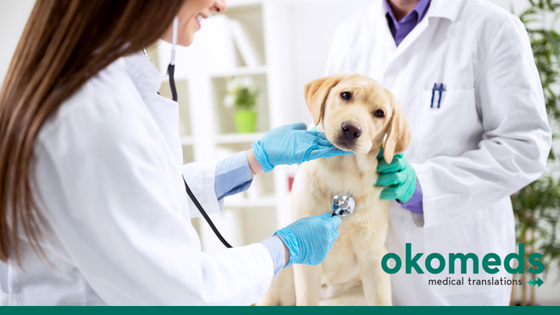
October 4 is World Animal Day, and here at Okomeds, we’re marking the occasion by turning the spotlight on a type of translation that’s extremely technical and yet quite obscure: veterinary translation.
What is veterinary translation?
This is a type of specialist translation dealing with documents relating to animal health, as well as animal production and animal feed. Some experts regard it as a subtype of medical translation, while others consider it to be a separate discipline.
What types of documents does veterinary translation cover?
Although it may seem like a rather narrow specialism as it encompasses everything to do with animals, the truth is that the texts can be very varied.
Texts aimed at animal health professionals
- Diagnostics and clinical studies: this section contains clinical reports on illnesses, laboratory test results, medical records, etc.
- Information on medicines: including pharmacological studies, scientific research articles, surgical materials, medicine leaflets, etc.
- Scientific dissemination: examples would include scientific articles on advances in veterinary medicine, treatment protocols, etc.
Documents aimed at professionals contain less typical texts, such as the following:
- Animal feed: articles on the composition of feed, supplements and related literature on animal nutrition.
- Livestock production: documents on livestock farming, hygiene and animal management, among others.
- Administrative and legal documentation such as health certificates, animal passports and other documentation required for their transport and trade.
Texts aimed at a non-specialist audience:
Documents aimed at an audience with less knowledge of the subject include public information materials such as leaflets, websites, awareness-raising articles and content aimed at pet owners.
Challenges faced by veterinary translators
In addition to the technical nature of veterinary translations, the various nuances and differences in terminology between human and veterinary medicine make veterinary translations among the most challenging when it comes to translating documents accurately.
Veterinary terminology requires a solid understanding of animal health and species-specific concepts. Resources such as the WOAH Terrestrial Animal Health Code glossary can help clarify specialised terms and their definitions.
The challenges faced by veterinary translators are as follows:
- Terminology can be full of nuances, and it’s easy to confuse medical terms with veterinary ones. For example, the English word ‘pregnant’ can be translated as either ‘in calf’ or ‘in pig’.
- It’s also important to bear in mind the animal’s age and breed, as a male calf is not the same as a female calf, nor is a heifer.
- It’s also vital to consider the animal species referred to in the text, as the terminology varies considerably depending on the text in question. Let’s not forget that information can range from a spider to an elephant, with everything that that entails.
- Veterinary clinics and the professions of those who work in them, because an exact equivalent doesn’t always exist.
- Vocabulary must be adapted accordingly depending on the text’s target audience. For example, if the target audience is a professional, terms such as ‘sarcoptic mange’ and ‘gastric dilatation volvulus’ will be used; if it’s a pet owner, words such as ‘scabies’ and ‘twisted stomach’ will be used.
For this reason, a translator of veterinary texts must have highly specialised and technical training in order to translate accurately and precisely. At Okomeds, we make sure to select just the right specialist professional translator for your text.
FAQs
Is medical translation the same as veterinary translation?
Although the latter is sometimes regarded as a subgroup of the former, they’re actually different disciplines. In the former, the texts feature humans only, and in the latter, animals only.
How technical is veterinary translation?
It’s a highly technical discipline, owing to the wide range of nuances in its vocabulary and the diverse audience that might read the texts.
Do translators of veterinary documents need to be specialists?
Yes. These are highly technical texts that call for a great deal of training and experience.