

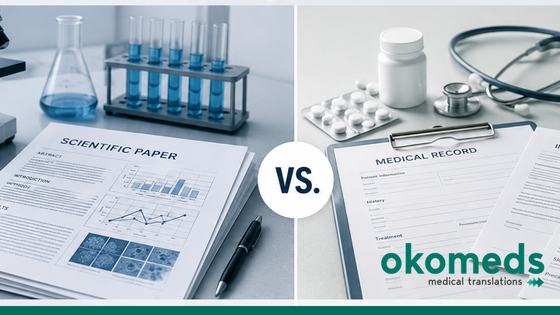


13 Aug Scientific Translation vs Medical Translation: What’s the Difference?
Although many people use both terms interchangeably, scientific translation and medical translation are not the same. Understanding the differences between scientific translation vs medical translation is essential when choosing the right specialist translator for your project.
Both fields require a high level of specialisation and share important characteristics such as terminological accuracy and rigorous writing standards. However, they apply to different types of documents and different areas of expertise.
Knowing these differences is essential in order to choose the right translator and ensure that the content retains its full accuracy, regardless of its purpose.
What Is Scientific Translation?
Scientific translation covers documents related to research and the dissemination of scientific knowledge in disciplines such as biology, chemistry, physics and engineering.
The most common types of documents include:
- Scientific articles
- Academic publications
- Technical reports
- Patents
- Research projects
- University documentation
This type of translation requires an excellent command of specialised terminology, academic conventions and the formats used in scientific publications. In addition, the translator must understand the scientific method in order to convey the results accurately without altering their meaning.
What Is Medical Translation?
Medical translation focuses on documents related to medicine, healthcare, clinical research and the pharmaceutical industry.
Examples include:
- Medical records
- Medical reports
- Informed consent forms
- Medicine package leaflets
- Clinical trial protocols
- Patient information materials
In addition to mastering medical and pharmaceutical terminology, the translator must adapt the language to the target audience. A document intended for a specialist does not require the same level of accessibility as a leaflet aimed at patients, where clarity is essential.
Scientific Translation vs Medical Translation: Key Differences
| Scientific Translation | Medical Translation |
|---|---|
| Covers multiple scientific disciplines | Focuses exclusively on medicine and healthcare |
| Translates scientific articles, technical reports and patents | Translates medical records, package leaflets, medical reports and pharmaceutical documentation |
| Mainly aimed at researchers, universities and R&D centres | Aimed at healthcare professionals, patients, laboratories and health authorities |
| Requires knowledge of scientific research | Requires expertise in medicine, pharmacology and healthcare documentation |
Imagine that a pharmaceutical company needs two documents translated:
- A paper presenting the results of research published in a scientific journal → Scientific translation
- The package leaflet for the medicine developed from that research → Medical translation
Although both documents belong to the healthcare field, their purpose, structure, terminology and target audience are different, which means they require different specialist skills.
In practice, medical translation can be considered part of scientific translation, since medicine is a scientific discipline. However, in the professional translation industry they are usually treated as separate specialisations because of their specific characteristics, terminology and document types.
Can the Same Translator Do Both?
That depends on the translator’s specialisation.
A scientific translator may be highly experienced in translating research articles but may not have sufficient expertise to translate a medical record or a pharmaceutical package leaflet. Likewise, a medical translator may be highly specialised in healthcare documentation without regularly working with scientific publications from other disciplines.
For this reason, specialist agencies assign each project to the professional with the most relevant expertise in that particular field.
Which Type of Translation Do You Need?
The choice depends on the type of document you need to translate.
If you are dealing with scientific publications, research reports or technical documentation related to a wide range of scientific disciplines, you will need a translator specialised in scientific translation.
If your content relates to medicine, pharmaceuticals, medical devices or clinical research, the most appropriate choice is a specialist in medical translation.
At Okomeds, we specialise in medical translation for the healthcare, pharmaceutical and life sciences sectors, working exclusively with experienced medical linguists. If your project involves scientific research or technical documentation outside the medical field, Okodia offers specialist scientific translation services across a broad range of scientific and technical disciplines. This ensures that every project is handled by a translator with the expertise best suited to your subject matter.
Frequently Asked Questions
Is scientific translation the same as medical translation?
No. Medical translation is a specialisation focused on medicine and healthcare, whereas scientific translation covers a much broader range of scientific disciplines.
Is medical translation part of scientific translation?
Yes. From an academic perspective, medicine is a scientific discipline. However, in the professional translation industry, the two specialisations are usually treated separately because of the differences in documentation, terminology and target audiences.
Can the same translator translate scientific and medical documents?
Only if they have the necessary training and experience in both fields. Specialisation is essential to ensure terminological accuracy and the overall reliability of the translated content.