



18 Abr What legal risk do you face when using AI to translate medical documents?
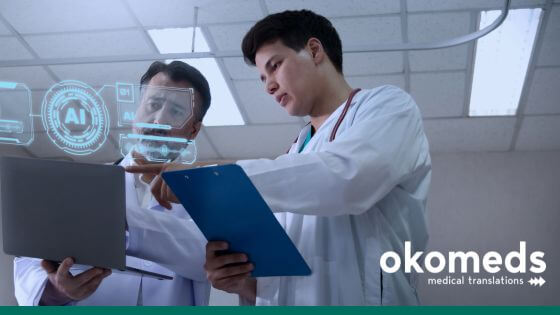
Artificial intelligence has become a common tool in content translation, including in the healthcare sector. However, when it comes to medical documentation, the margin for error becomes a clinical and legal risk. And more and more regulatory bodies are focusing on this.
The false sense of security created by AI
The rise of AI has led many companies to automate translation processes without reviewing their suitability. According to the European Medicines Agency, all documentation submitted in regulatory processes must be «clear, precise and scientifically accurate», especially for materials aimed at patients. This includes informed consent forms, technical information sheets and leaflets. A translation that does not respect these criteria may lead to rejection in authorisation processes.
When language directly affects patient safety
The World Health Organization has pointed out in several reports on patient safety that communication errors are one of the most common causes of preventable clinical incidents.
In the field of medical translation, this translates into problems such as:
- Incorrect interpretation of symptoms or side effects
- Ambiguous clinical instructions
- Loss of relevant nuances in the patient’s medical history
These errors can lead to inappropriate medical decisions or delays in treatment.
Regulatory and compliance risks
In Europe, regulations require medical information to be understandable to the patient. The EMA states that texts must be linguistically validated and adapted to the target audience.
In addition, the use of automated tools raises data protection concerns. The General Data Protection Regulation (GDPR) requires specific guarantees when handling health data, considered especially sensitive.
The use of uncontrolled AI platforms may involve data transfers outside a secure environment, which poses a significant legal risk.
AI can help, but only under expert control
AI can be useful as support in translation processes, but it does not replace specialised human validation. In environments such as pharmacovigilance or clinical trials, where terminology must conform to standards such as MedDRA, the involvement of experts is essential.
The challenge is not to avoid technology, but to properly integrate it into controlled processes. Because in the medical field, a translation not only has to be correct: it has to be reliable, verifiable and safe.
No Comments